Friday, May 8, 2020

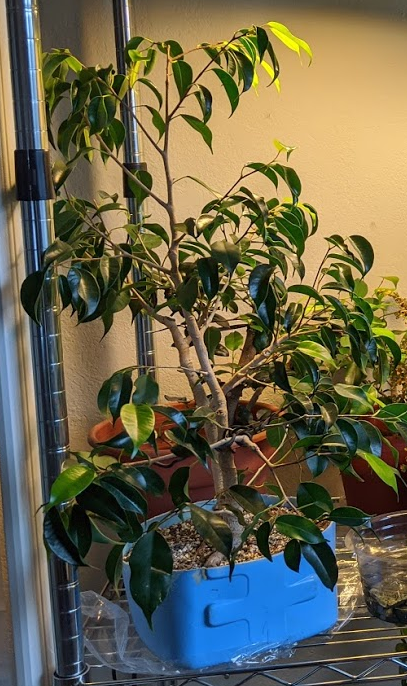
Ficus Benjamina #3 Progression

The exact origins of this one are unfortunately lost in the murky depths of prehistory... It's likely it started as a branch on the mother of all ficuses that this greenhorn has had for 12 years or so. Having been clipped off the mother tree, it likely was rooted in water and then potted up. And perhaps during the rooting process or a little later, it was deemed interesting to grow some aerial roots on it, and the tree obliged with three.


Around the 2019 vernal equinox, it got repotted into a special, custom made pre-bonsai training pot (Kirkland detergent can cut in half, holes drilled, and spray painted UN peace keeper blue).


In search of a decent nebari, one of the rear roots was bent around and brought to the front from under the trunk. If this works, it'll be quite a coup.

The potential of this tree to be a twin trunk classic (a la Peter Chan's famous Japanese Maple) wasn't lost on the novice. So some wiring was done to get the criss-crossing branches out of the way, and still make it all look pleasing to the eye.

And then the tree was generally ignored, as it basically did nothing interesting for an year.

In the winter of 2019, it was brought indoors and kept under artificial lights. And there, after a while, the tree finally seemed to decide it might just want to grow a few new leaves after all.


Forced to spend all waking hours with this tree, thanks to the great pandemic of 2019, the tyro stopped ignoring it, and started to rather appreciate it. Accordingly, it was determined that the tree deserved a promotion to a new pot - another custom made beauty! (A $1 plastic box spray painted black. That lucky tree!)


 Cinco de Mayo de 2020 had just passed, but this time the invader was still winning. By now, one of the aerial roots in the front of the tree had taken a rather undesirable turn, lapping over the other one and heading in the wrong direction, spoiling the radial symmetry that's desirable in the nebari. So that one had to go. Adios. Upon more inspection of the root mass, two other rather thick ones were noticed and with only a slight hesitation, were cut off as well.

So, this tree didn't have a good day. It lost a good chunk of its roots. All for what, a silly new plastic pot? Wait tree, you will in time realize it was not only not so bad, it was in fact a great day. So believes the neophyte, anyway.


Back under the familiar CFL and LED lights, having lost many roots but gained a $1 pot and some fancy new soil mix (lava rock, Napa oil dry product, sand, MiracleGro potting mix, perlite, Osmocote slow release fertilizer), sits majestically this Ficus Benjamina. Only time will tell if the root loss results in any foliage loss.

The rookie hopes not.

And oh by the way, that hopeful nebari experiment turned out to be a failed coup - no sign of that root was to be found. Oh well.


End of August, Post Covid era, year #1 update. Absolutely no foliage loss after the brutal root pruning back in May! The tree has been almost entirely sitting in artificial light, since the estudianté didn't want to risk the root deprived tree in the summer sun and occasional winds. So it did some slow growing. But it has been apparent it's getting a bit too leggy, and the top need to be trimmed. After agonizing about it
for weeks, the pupil became decisive on a late August Sunday afternoon. And the result is not so bad...


The vision the padawan has in mind for this tree is like so: 


Thursday, April 2, 2020

Privet Air Layer to Pre-bonsai

There is this hedge bordering the lawn on our front yard, that gets trimmed and shaped to look like a monolithic mass. It looks me a good 7 years to take a closer look at it and realize that there at least 3 other shrubs there apart from the dominant juniper. And thanks to PlantNet and PictureThis apps, I identified one of them as a privet. It caught my attention because it has leaves that aren't too big (not more than 1.5 inches), has woody stems and seems to back-bud easily. Free bonsai material!

So in late April 2019, I started an air layer in a branch about 1.5 inches in diameter. I couldn't do a great job of it, since it was very hard to reach the back side of the branch to cut the girdle. I wasn't even sure if I covered all of the wound with the wet moss.

I had pretty much ignored this for the next few months, mainly because I was too lazy to go behind the hedge and squat there to take a look at this. But in August 2019 I finally overcame the laziness, got down there and unwrapped the plastic bags covering the moss to find a bunch of those moisture loving critters hanging out there. Once I cleared them, I found that the girdle was callousing over already. But a couple of adventitious roots had appeared at a different spot, a little above the girdle. Go figure! I probably should have wrapped it again with wet moss to let the roots develop. But I knew I'd be too lazy to check back for a few months and may lose the cutting. And I was a bit impatient to have a few pre-bonsais in pots.

Sep 8, 2019

So, I sawed off the branch, and after some pruning, planted it in a sandy potting mix along with some lava rock, in a 10 inch plastic pot. 

After 2 weeks, it was full of new sprouts, and looked ready to go!

Sep 21, 2019
About a month hence, I decided to trim down the lanky branches, to encourage more lower-level  branching.

Oct 16, 2019

It wintered indoors... (Trust me, it's in there somewhere in that jungle!)

As I kept looking at it every so often, it became very clear that the taper-less trunk needed to be cut back. But why waste a good trunk? So I air-layered off the top couple of inches!

Feb 16, 2020


Once Spring officially arrived, it was time finally to repot it and move it outdoors again. 

Mar 31, 2020

The wound near the base looks ugly indeed. I'd probably try to gouge it out some more and see if it tries to heal over. I really hope so, otherwise it's quite an eyesore. Also, the trunk needs to be cut back some more, and a new apex developed. 

To be continued... 


Wednesday, September 4, 2019

Pomegranate Air Layer

Back in the spring of 2019, I decided to start a few air-layer attempts on Japanese maple, Crepe Myrtle, Pomegranate and a Privet. This is not my first attempt - I tried a couple of years ago (on a ficus?) and gave up when it failed, since I didn't see the point. Now I do. It's an awesome short-cut to get a thick trunk - the single most important thing for a bonsai!

The air-layering technique consists of scraping off a ring of the bark and cambium layers from a branch, wrapping the wound with wet moss, perhaps after apply some rooting hormone, and covering it with plastic sheets to keep it from drying out. The cambium will be tricked into developing roots at the upper edge of the ring, while the xylem/phloem inner layers keep the branch alive. After a few weeks, when there are enough roots, cut off the branch and plant it in soil to get a new tree. That is, if all goes to plan.

Out of the 5 attempts this time, I got 5 different results! One of the Japanese maple layers briefly rooted. But three and a half weeks later (I was out of town), the whole branch had died. This was part of a bigger branch which seemed to be dying off bit by bit... so may be it wasn't my fault. The other JM air layer (in a healthier branch on the same tree), simply calloused over - no sign of roots. It was bumpy sort of callous, which perhaps always accompanies rooting. I scraped off the callous and re-wrapped it in wet moss, to give it more time. The crepe-myrtle also closed the gap with no signs of rooting. But this callous was smooth, and looked less promising. The privet ignored my wound, and grew a couple of roots at a different spot! I cut it off and planted it in soil. Hope it pulls through.

The pomegranate was the best of the lot. The air-layer was started on 11th May 2019, and by mid August, there were clear signs of rooting along with bumpy callousing. I gave it a good spray of water and let it sit for couple more weeks.  Then on Labor Day, I cut it off and planted it in a pot. I couldn't resist the urge to peel off as much of the moss as possible to take a good look at the roots. Hope I didn't damage too may roots in the process.


Now the wait to see if it survives...


Monday, June 24, 2019

Ficus Benjamina "Phoenix"

Earlier this Spring (March 2019), I had what I now know with reasonable certainty, a wide spread spider-mite infestation among many of my potted plants, especially the ficuses. See this post for more gory details. Among the victims was one of the Ficus Benjamina cuttings that was a couple of years old. and not really targeted as a pre-bonsai, but a favorite nevertheless. Before realizing that it was a spider-mite problem, I was frantically searching for solutions, as the plants were declining fast.

This particular plant was declining faster than others - yellowing leaves that were wilting away...  I noticed that the water wasn't draining well. When I dug up the roots,  I was shocked to find a big tuber (or a "tumor" as I felt it was). Too bad, I didn't take any pictures. I guessed that the tuber in the root was probably a reaction to the poorly draining soil (is that how they develop all those ugly ginseng ficus "bonsai" with those hideous roots?). And so I replaced almost all the soil, with some coarse sand added in.
Spider-mites, plus a horrific root chop in April 2019

After a couple of weeks, in mid April 2019, while the drainage had definitely improved, the plant was still declining. Then in desperation, I decided to chop off the tuber. Unfortunately, in my haste, I cut off 90% of all roots. At that point, I knew I had killed the plant.


Keeping fingers crossed, I kept the plant indoors, kept it misted as much I could... but it dropped all leaves in a matter of days.

Not looking good!
By mid May 2019, it looked dead


A rebirth!

But, in another 10 days are so, some signs of life emerged! There was visible greening in one of the lower branches. And then in another branch.

By the second week of June it was beyond doubt that the plant was recovering... rather having a re-birth!


June 23rd 2019

And now, it has leafed out well in some branches, while others are clearly dead. But interestingly it has also sprouted a number of what could probably be called "adventitious buds", something I thought Ficus B. never did. So, a few new things learned!


October 13, 2019 

Yes, there a some dead branches, but it has more than made up for them and greened out nicely all around. It's so gratifying to see this tree revive itself. 


December 8, 2019


For a while I thought I'd keep the dead branches around as a reminder of what this tree has been though. But they just looked messy, and I have this blog to remind myself - so cut them off.

And now that the tree is solidly alive again, it's time to mess around with it again ;) Trying a new fusion technique - got a rooted cutting (from another ficus b.) and set it on top of that long left branch and trained the roots down the trunk line. Wrapped the roots with wet cloth and plastic tape. The idea is to mimic a "strangler" - like these trees do in the wild. 


April 4th, 2020

The roots of the strangler have reached the soil and should be able to sustain it now. 

Added a wire to shape one of the branches.

Also, trying a thread grafting experiment. You can see it right above the wired branch. Clipped off an "eye poker" branch, and made a cutting out of it; drilled hole in the trunk, inserted the cutting and covered the bottom end with wet moss. Let's see if this works. 

If it does, it can be a game changer for my Ficus B. work. 


Saturday, June 8, 2019

Ficus Benjamina Fusion


When I saw the world's largest tree named General Sherman Tree, in the Sequoia National Park in California, I thought to myself that it looked like at least two trees fused together.


Several other gigantic trees in that park were fused multiple trunks.


That reminded me of the potted ficus trees at home with fused trunks. And ironically, looking at that gigantic tree gave me the idea to try a ficus fusion bonsai! (Later I googled it and found that I wasn't the first one to think of that, of course!)

Since I have a regular supply of ficus benjamina cuttings from the several house plants we have, it wasn't too hard to get started. I started several cuttings in the Summer of 2018. Two were straight and woody with very few branches - these I thought will just provide the bulk for the trunk. Others were thin and more ramified.


In all I probably had 6 or 7 cuttings. In mid September 2018,  after all of them had rooted sufficiently, I bundled together with twist ties and string and planted them in a mix of mostly potting soil , along with some some lava rock, fine gravel and Napa oil dry thrown in (notice the classy yogurt container pot ;)


I know some folks do more elaborate stuff like using some special paper/cloth to wrap the trunks. I don't know if that's necessary. Time will tell...


Fast forward to May 2019, and... well, not much to get excited about. Still no sign of any fusion, though the cuttings are doing great. As part of the ficus trouble shooting experiments, I repotted this and got rid of all the lava rock, since that was one of my suspects (it likely was spider mites, as I detail in this post).


So the wait continues... the plants spend all the time outdoors now that the weather is great. 

Thursday, May 9, 2019

Ficus Benjamina Bonsai from "Air Layer"

I had this lanky ficus almost 3 feet tall with no foliage below the top few inches of the uniform, straight trunk about a cm thick. So I thought, why not chop off the head and try to train it into a bonsai. I wasn't sure such a big "cutting" would root properly if I just chop it off and keep it in water, like I usually do for ficus b. cuttings. And I had always wanted to try an air layer anyway. So took a knife to the plant on April 15, 2018.


After scraping off the bark and cambium layers from about an inch of the trunk, covered it with wet moss and wrapped it up.


In two weeks, opened the wrap up and noticed a funny thing. It had rooted vigorously, but not from the scraped area, but from intact bark. Go figure!


May 3, 2018: Cut off the rooted head. In other species, one should probably wait until there are a lot more roots. But ficus is so easy to root and propagate, one can get away with this kind of impatience.


May 12, 2018: the cutting is in water for further root development.

After a couple of weeks, it was moved to a training pot with a soil mix consisting of lava rock (filtered to be about 1/4"), coarse sand (filtered out from homedepot play sand) and Miraclegrow potting mix. I even managed to get it to develop some aerial roots from the lowest branch.


Mar 25, 2019: Six months of TLC (some branch pruning, indoor LED lighting over the winter, aerial root management) yielded a vigorous and well ramified pre-bonsai.


But then, things started to take a turn for the worse... In fact, for at least a few of months by this time, I had been noticing that several of my ficus b. plants weren't looking right. The leaves looked pale, dusty (but won't wash off), some leaves, especially in the variegated plants would curl up, etc.


I suspected it could be one of 3 things:

  1. the lava rock in the soil
  2. the excessive use of LED lighting
  3. over fertilization

But I never suspected it could be pests until late. The current suspect is spider-mites. See my post on that.


The status as of May 9, 2019 is, in spite of frequent spraying (with rubbing alcohol, neem oil, insecticidal soap alternately), the plant doesn't show obvious recovery, though it's not deteriorating either. There is also probably some sun burn due to the plants being outdoors all the time now, including several hours of direct sun.


May 28, 2019: The spider-mite problem seems to be under control, finally!

Gave this guys a pot upgrade (Costco Kirkland Brand Laundry Detergent Can cut down and painted white - the perfect trainer pot!). Filled in with a mix of .5" lava rock, .25" gravel and MG potting mix. Did a bit of leaf pruning to get rid of sick and very large leaves (taking care to leave at least a bud at the end of the branch).

Hope this guy, christened "Twister", has a happy summer!!


Ficus Microcarpa

This blog entry will be a journal of the progression of my Ficus Microcarpa tree. 

I got this cutting from a fellow plant lover. 
She started the cutting in water in late October 2018

After a few weeks I transferred it to some potting mix, and it made steady progress. Here it is on 23 March 2019


March 30, 2019: Decided to try the "tile method" to develop surface roots. Used a piece of tae kwon do breaking board, sanded the edges and applied two coats of Welbond glue to laminate it. Placed the "tile" in the training pot over 90% of the soil, then spread the roots over it, and added a thin layer of soil on top. Secured the plant with some wires.


April 25, 2019: Did a bit of wiring to give the trunk some movement. 


November 2nd 2019: Look at it now, one year on from being a mere cutting! It's developing into a beautiful little tree. The past couple of months, it spent outside in great summer-fall weather. But now it's time to bring it inside, and continue to develop under artificial light. I was even able to clip a branch to make a new cutting - hopefully that branch will develop more ramification. If it does, a couple of other branches will also need clipping sometime soon. So I'll have a few new cuttings. Perhaps I can attempt a trunk fusion with those!